
San Mateo County September 2026 Market Report
September 2026 San Mateo County Housing Market Report: Slower Appreciation, Faster Sales, and a Tighter Market Than the Price Data Suggests
Data through August 2026
August produced a set of numbers that look contradictory at first glance. Price appreciation slowed sharply, from roughly 10% year over year in July down to 5% in August. At the same time the market got measurably more competitive: homes sold faster, more of them closed above asking, inventory tightened further, and months of supply fell. Slower price growth and a tighter market are not usually the same story. Here is what the data actually shows.
The Macro Backdrop
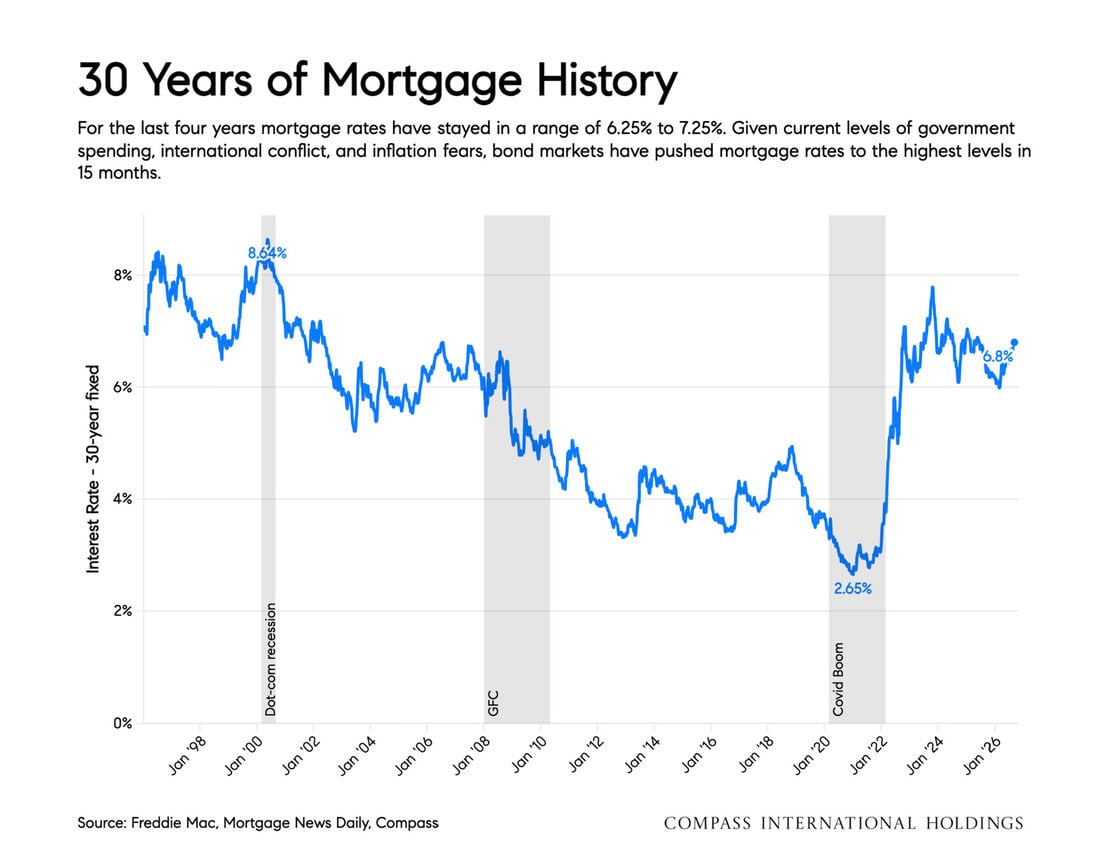
Mortgage rates are stuck at 6.8%, near a 15-month high. For four straight years rates have traded in a band between roughly 6.25% and 7.25%, and bond markets have pushed them toward the top of that range on government spending, geopolitical tension, and persistent inflation fears. There is no meaningful rate relief on the near horizon.
The labor picture cuts both ways. Nationally, August payrolls showed signs of acceleration, with 2026 now averaging about 80,000 new jobs per month. Stronger hiring supports homebuyer demand, but it also adds inflation pressure and argues for rates staying higher. The Bay Area has not participated: the region has posted almost no net job growth this year, with five consecutive months of a shrinking labor market. The national hiring rate sits at just 3.2%, which matters for housing because relocation for work is one of the biggest drivers of home sales. People are employed, but they are not moving.
The regional price picture has also reshuffled. San Francisco remains the standout at 24% year-over-year appreciation, but the second-strongest gains in August came from north of the city, with Marin and Napa both at 12%. San Mateo County and Contra Costa came in at 5%. Alameda was flat, and Santa Clara, Santa Cruz, Sonoma, and Monterey all posted declines.
San Mateo County: Where Things Stand
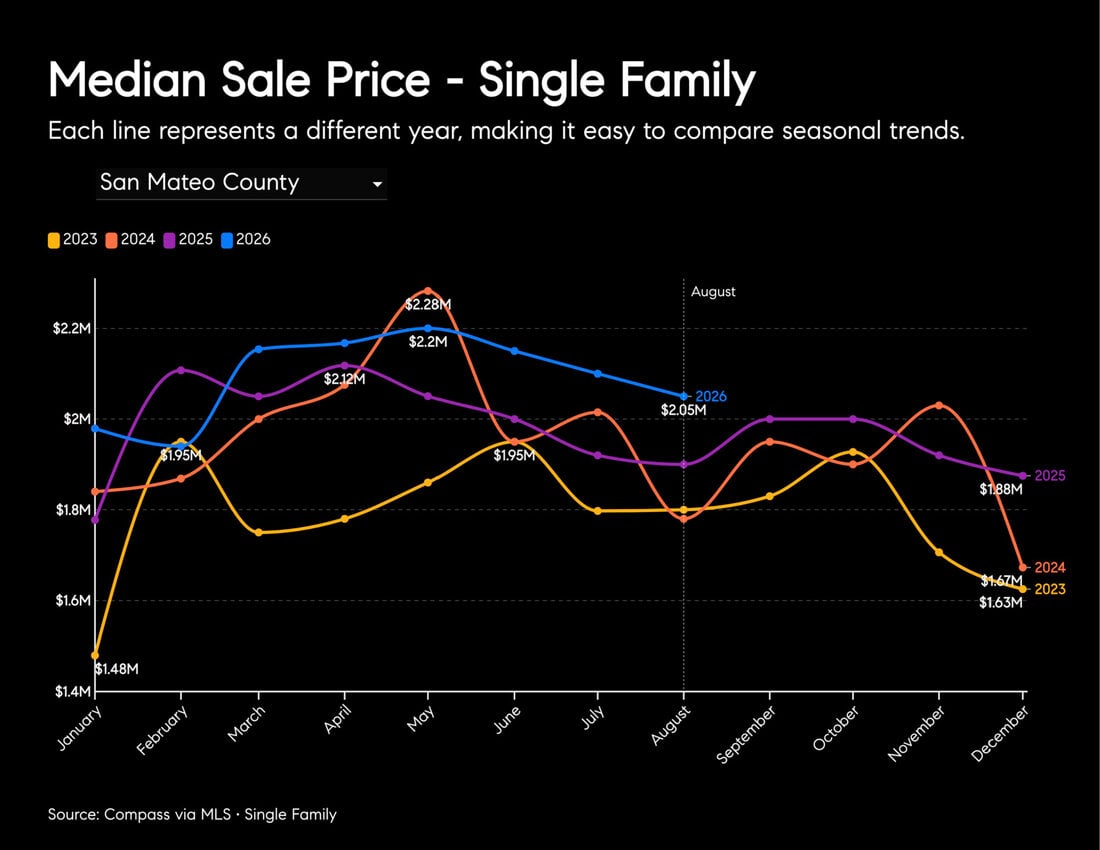
The median single-family sale price finished August at $2.05 million, up about 5% from last August and down 5% from July. That is a real deceleration from the summer, when the county was posting near-double-digit annual gains. The 2026 line is still tracking above 2025 in every month, but the gap has narrowed considerably since May.
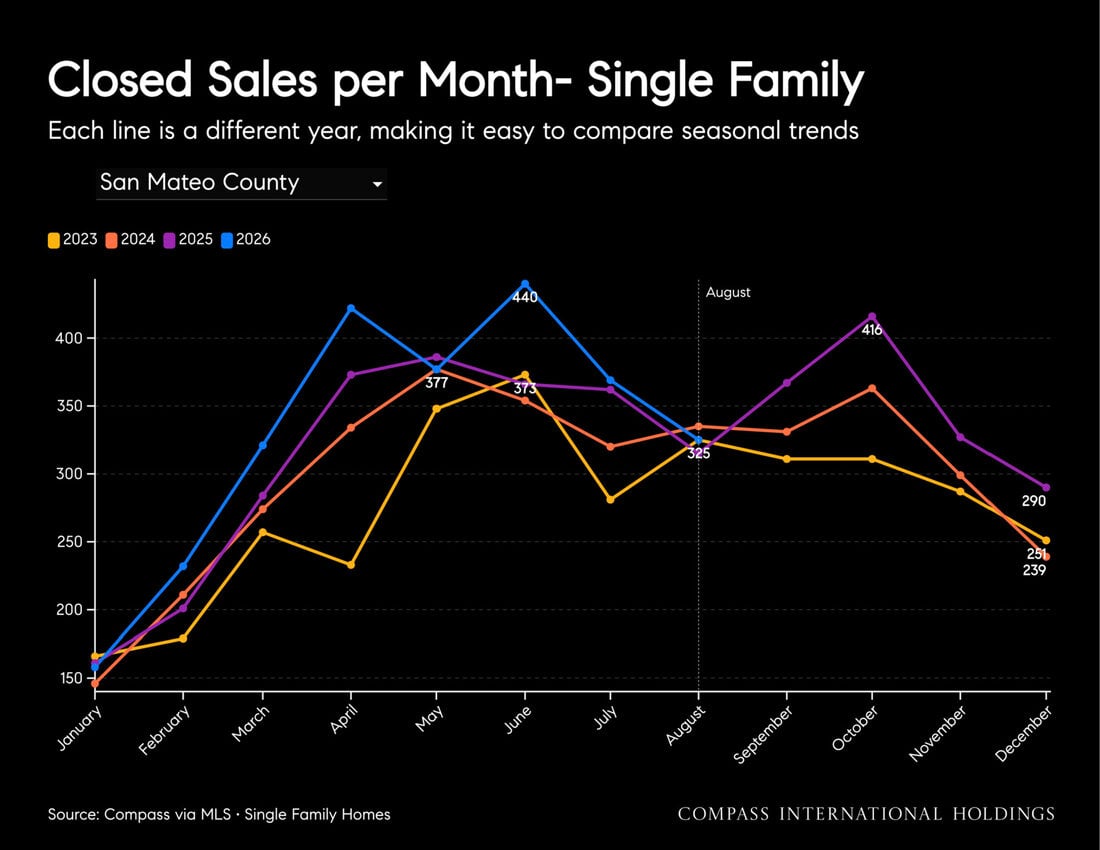
Sales volume came in at 327 single-family closings, down 11% from July. The month-over-month decline is ordinary late-summer seasonality, and it happened across the region: closings fell month over month in 12 of 14 Bay Area counties in August as the market moves from its summer peak toward the fall market.
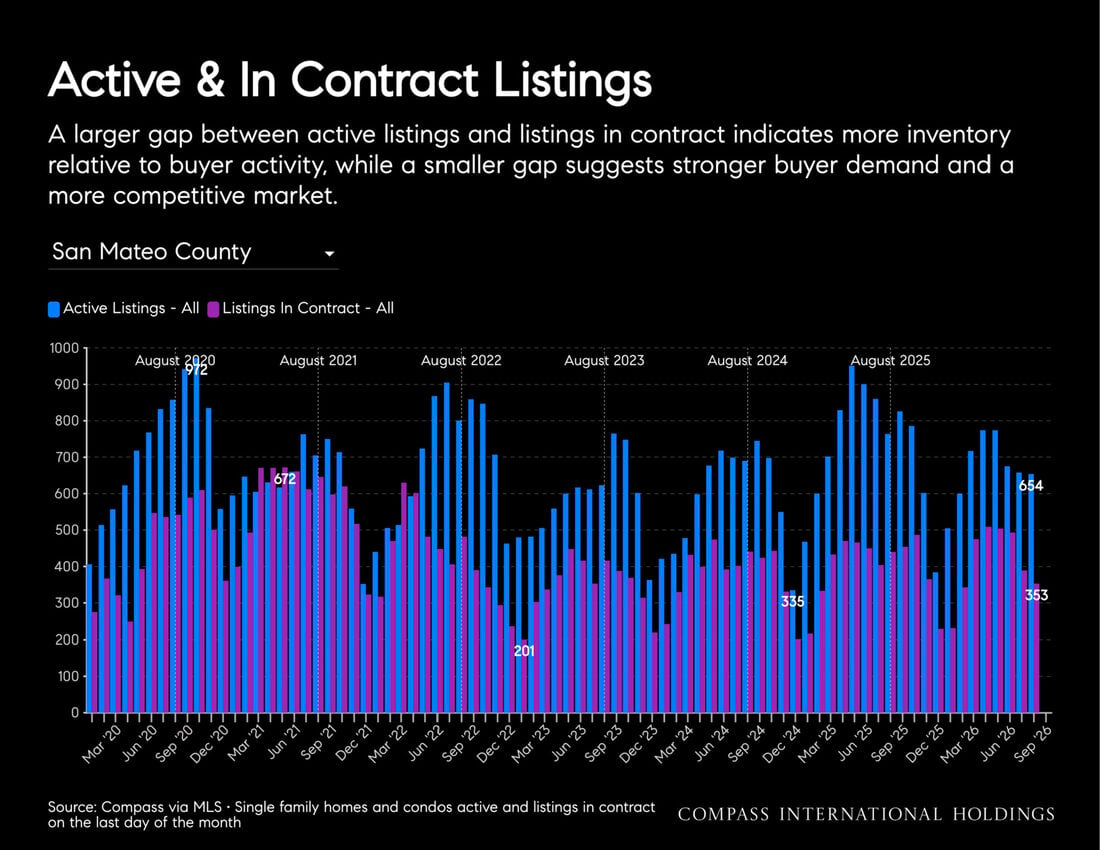
Inventory kept tightening. Combined active listings fell about 16% year over year to roughly 640, with single-family actives down 17% and condos down 14%. What makes that notable is that it happened despite new listings rising 3%. Supply is not shrinking because sellers stopped listing. It is shrinking because buyers are absorbing what comes to market faster than it arrives.
The absorption numbers confirm it. The single-family absorption rate improved 6 points to 75%, and months of supply fell from 1.7 to 1.3. Single-family price reductions dropped 24%. Average days on market fell from 30 to 25.
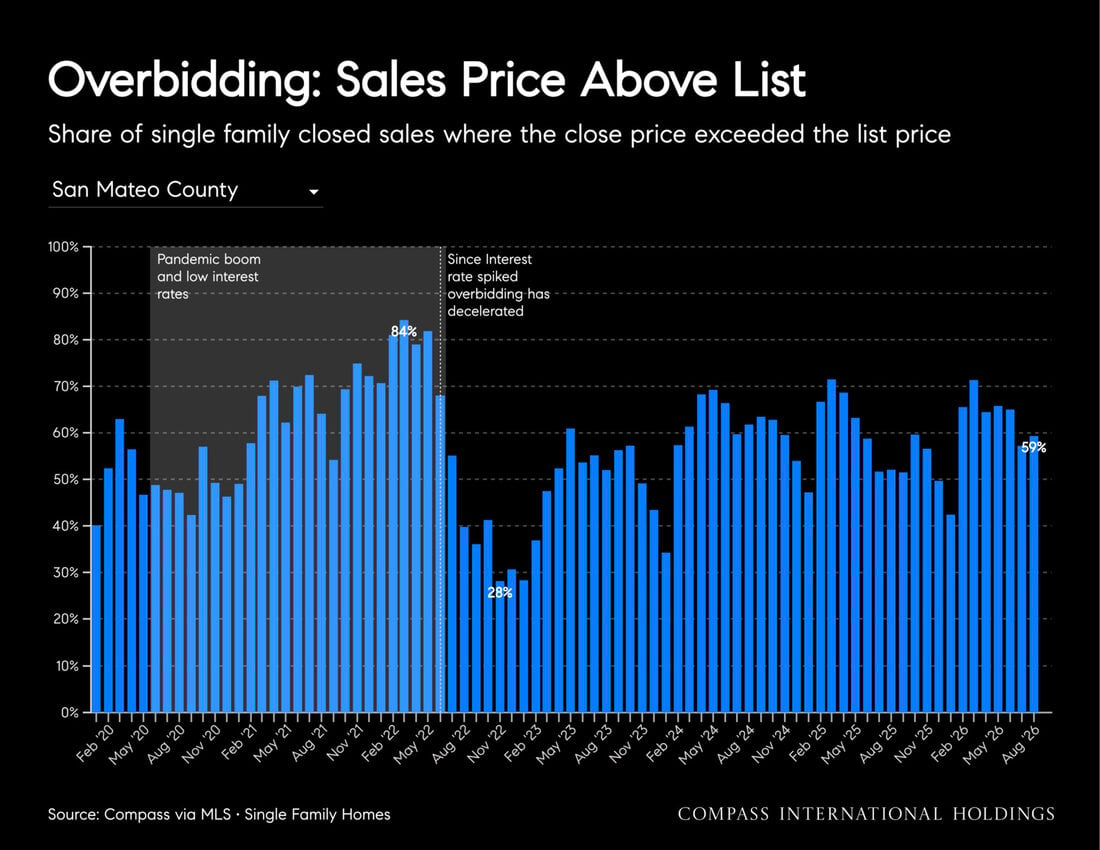
Competition also intensified. Roughly 60% of single-family sales closed above their list price in August, up 9 points from a year ago and up 3 points from July. That is the clearest signal in this month's data. When the share of homes selling over asking rises while the median price growth slows, it usually means the mix of what sold shifted toward lower price points rather than that demand weakened.
The condo market is the softer half of the story. The condo median held flat at $820,000 and price per square foot was flat at $744. Closings came in at 73, down 1% year over year and 13% from July. The bright spot is speed: condo days on market improved dramatically, from 80 days to 54. But condo contracts fell 22%, absorption slipped to 31%, and condo price reductions rose 17%. Months of supply did decline from 3.3 to 2.8, though that reflects inventory contracting rather than demand improving. August was also the first month of data following new condo lending regulations, so it is too early to separate a regulatory effect from normal late-summer seasonality.
Bottom Line
The headline number cooled and the underlying market did not. Appreciation at 5% is half what the county posted a month ago, but homes are selling in 25 days instead of 30, six in ten are closing above asking, price reductions are down by nearly a quarter, and there is only 1.3 months of single-family supply on the ground.
For sellers, the operating conditions are better than the price headline implies. Inventory is scarce, absorption is strong, and buyers are competing. The caution is that the price ceiling has come down from the spring. Pricing to last May's comparables is the mistake to avoid.
For buyers, this is a difficult market to negotiate in on single-family homes, with 1.3 months of supply and a rising overbid share. The condo market is the genuine opportunity right now: flat pricing, rising price reductions, weaker contract activity, and 2.8 months of supply give buyers leverage that simply does not exist on the single-family side.
The thing to watch into fall is whether condo softness is a regulatory artifact or the start of something broader, and whether the Bay Area's five-month run of labor market contraction eventually reaches Peninsula housing demand. So far it has not.